
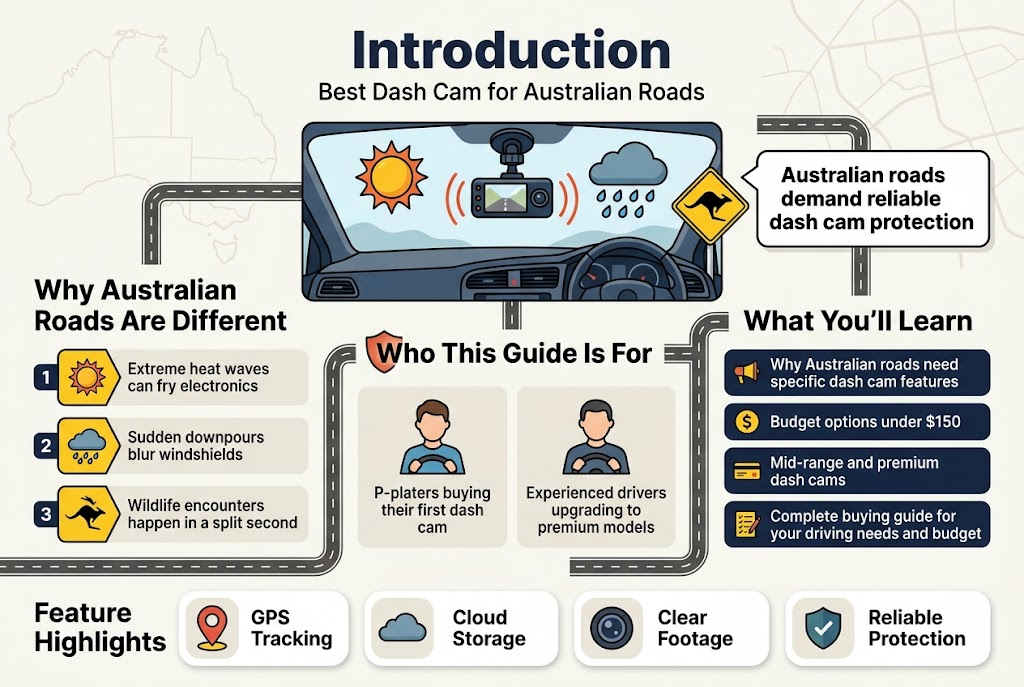
Australian drivers face unique challenges on the road – from extreme heat waves that can fry electronics to sudden downpours that blur windshields and wildlife encounters that happen in a split second. Finding the best dash cam for Australian roads means choosing a device that can handle our harsh conditions while capturing clear footage when you need it most.
This guide is for Australian motorists who want reliable protection without the guesswork – from P-platers buying their first dash cam to experienced drivers upgrading to premium models. We’ll break down why Australian roads demand specific dash cam features that differ from overseas models, then walk through budget options under $150 that won’t let you down. You’ll also discover mid-range and premium dash cams that offer advanced features like GPS tracking and cloud storage, plus a complete buying guide to help you choose the right model for your driving needs and budget.
Why Australian Roads Demand Specific Dash Cam Features
Extreme weather conditions and UV resistance requirements
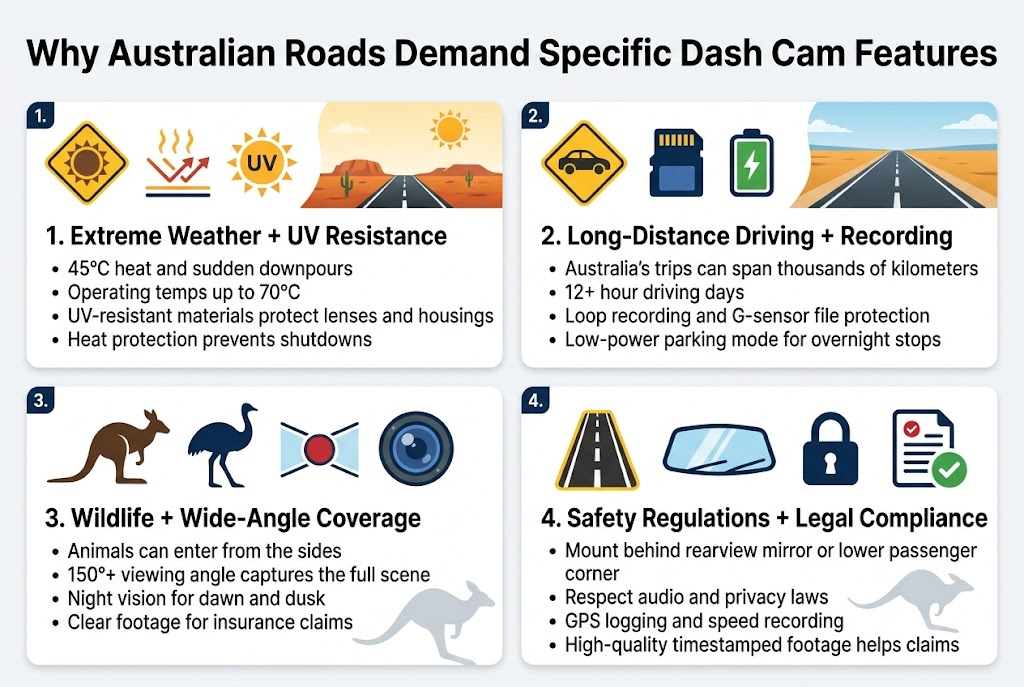
Australian weather throws everything at your dash cam – from scorching 45°C summers in the Outback to sudden downpours that can flood roads in minutes. Your dash cam needs to handle these extremes without missing a beat. The intense UV radiation across the continent can destroy cheaper electronic components and fade plastic housings within months.
Heat resistance becomes critical when your car sits in direct sunlight all day. Many dash cams shut down or malfunction when interior temperatures exceed 60°C, which happens regularly in Australian parking lots. Look for models with operating temperatures up to 70°C and built-in heat protection features.
UV-resistant materials prevent lens degradation and housing brittleness that could leave you with useless footage when you need it most. The harsh Australian sun can turn cheap plastics yellow and crack LCD screens, making your investment worthless.
Long distance driving and extended recording needs
Australian road trips aren’t quick jaunts – they’re epic journeys measured in thousands of kilometers. A drive from Sydney to Perth covers nearly 4,000km, and that’s just one route across this massive continent. Your dash cam must handle continuous recording for 12+ hour driving days without overheating or corrupting files.
Loop recording becomes essential for these marathon drives. Standard memory cards fill up quickly during long hauls, so your dash cam needs intelligent file management to overwrite old footage while preserving important incidents. Choose models with G-sensor protection that automatically locks crash footage.
Power management matters when you’re camping overnight between driving days. Parking mode features let your dash cam monitor your vehicle while you sleep, but they need low-power consumption to avoid draining your battery in remote locations where jump-starts aren’t available.
Wildlife encounters and wide-angle coverage benefits
Kangaroos don’t follow traffic rules, and neither do the wombats, emus, and wild boars that regularly wander onto Australian roads. These unpredictable encounters happen fast and often come from the sides, making wide-angle coverage absolutely essential for capturing complete incident footage.
Standard 120-degree viewing angles miss crucial side action when a kangaroo bounds across your path. Premium dash cams with 150+ degree coverage capture the full picture, showing exactly where animals came from and how the incident unfolded. This comprehensive footage proves invaluable for insurance claims and understanding what went wrong.
Night vision capabilities become critical since many Australian wildlife encounters happen during dawn and dusk when animals are most active. Enhanced low-light sensors help capture clear footage of these incidents when standard cameras would only record darkness.
Road safety regulations and legal compliance considerations
Australian states have varying regulations about dash cam placement and usage, making compliance knowledge essential before mounting your device. Most states prohibit anything that obstructs driver vision, typically requiring dash cams to sit behind the rearview mirror or in the lower passenger corner of the windscreen.
Privacy laws affect how you can use and share dash cam footage. Recording audio requires understanding consent regulations, particularly when passengers or other drivers might be captured. Some states have specific rules about recording in private property or school zones.
Insurance companies increasingly accept dash cam evidence for claim processing, but footage quality standards matter. Blurry or poorly timestamped videos may not hold up during disputes. GPS logging and speed recording features provide additional verification that insurance adjusters value when determining fault in accidents.
Budget Dash Cams That Deliver Value Under $150
Top performing entry-level models with essential features
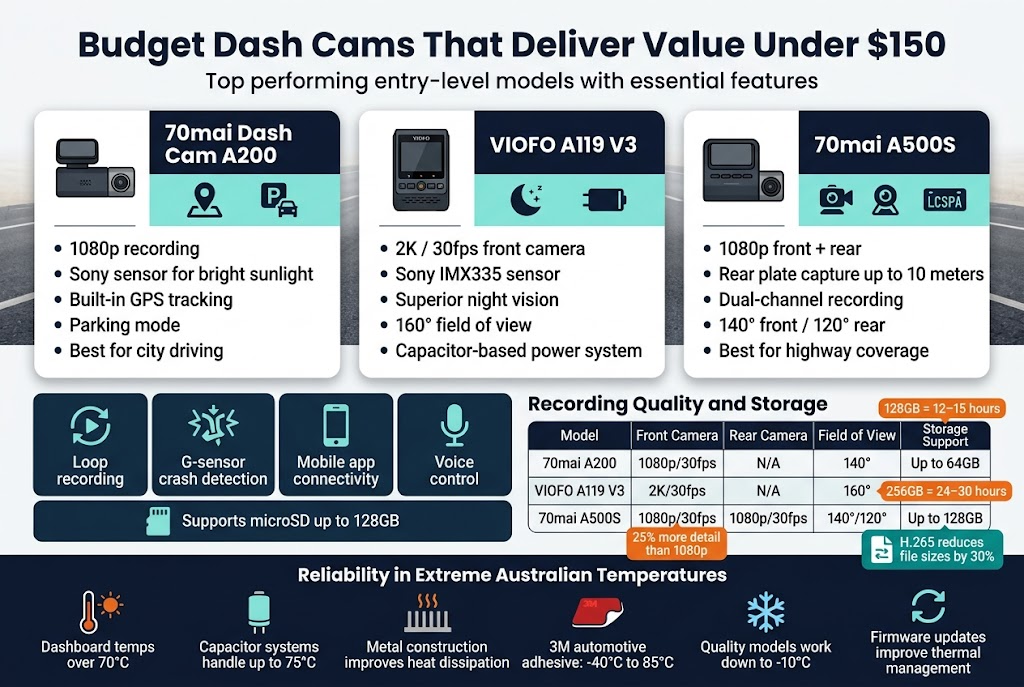
When shopping for dash cams under $150, three models consistently outperform their competitors. The 70mai Dash Cam A200 offers excellent 1080p recording with a reliable Sony sensor that handles Australia’s bright sunlight without washout. Its built-in GPS tracking and parking mode make it perfect for city driving and overnight protection.
The VIOFO A119 V3 stands out with its superior night vision capabilities, using a Sony IMX335 sensor that captures clear footage even on poorly lit country roads. The compact design won’t obstruct your view, while the capacitor-based power system ensures reliability during power fluctuations.
For dual-channel recording, the 70mai A500S provides both front and rear cameras within budget. The rear camera captures license plates clearly up to 10 meters, essential for Australian highway speeds where following distances are greater.
All three models include essential features like loop recording, G-sensor crash detection, and mobile app connectivity for easy file management. They support microSD cards up to 128GB and offer voice control functionality that keeps your hands on the wheel.
Recording quality and storage capacity comparisons
Recording resolution varies significantly across budget models, directly impacting their ability to capture critical details on Australian roads.
| Model | Front Camera | Rear Camera | Field of View | Storage Support |
|---|---|---|---|---|
| 70mai A200 | 1080p/30fps | N/A | 140° | Up to 64GB |
| VIOFO A119 V3 | 2K/30fps | N/A | 160° | Up to 256GB |
| 70mai A500S | 1080p/30fps | 1080p/30fps | 140°/120° | Up to 128GB |
The VIOFO A119 V3’s 2K resolution provides 25% more detail than standard 1080p, making license plate identification possible even at highway speeds. Its 160° field of view captures more of the roadside, crucial for documenting wildlife encounters or debris incidents common on Australian highways.
Storage capacity directly affects recording duration. With 128GB cards, expect 12-15 hours of footage before loop recording overwrites older files. The A119 V3’s support for 256GB cards extends this to 24-30 hours, providing better coverage for long road trips across the continent.
Compression efficiency varies between models. The 70mai cameras use H.264 encoding, while VIOFO implements H.265, reducing file sizes by 30% without quality loss. This means longer recording times with the same storage capacity.
Reliability factors for extreme Australian temperatures
Australian summers test dash cam endurance like nowhere else. Dashboard temperatures regularly exceed 70°C in summer, while winter mornings in alpine regions can drop below freezing.
Capacitor-based power systems significantly outperform lithium batteries in extreme heat. The VIOFO A119 V3’s capacitor design operates safely up to 75°C, while battery-powered alternatives may shut down or suffer permanent damage at 60°C. During Adelaide’s 46°C heatwave in 2019, capacitor-based dash cams continued recording while many battery models failed completely.
Heat dissipation design matters enormously. Models with aluminum heat sinks or thermal pads transfer heat away from sensitive components more effectively. The 70mai A200’s metal construction helps maintain stable operation, while plastic-bodied alternatives often experience overheating shutdowns during peak summer conditions.
Cold weather affects startup times and screen responsiveness. Quality budget models maintain functionality down to -10°C, adequate for most Australian conditions except alpine regions. Screen dimming or slower response times are normal in cold weather but shouldn’t prevent recording.
Mounting adhesive quality becomes critical in temperature extremes. 3M automotive-grade adhesive, included with recommended models, maintains bond strength from -40°C to 85°C. Cheaper alternatives may fail during hot summers, causing costly dash cam drops or loss.
Regular firmware updates from manufacturers address temperature-related bugs and improve thermal management algorithms. Models from established brands like 70mai and VIOFO receive consistent updates, while unknown brands often abandon support after initial sales.
Mid-Range Dash Cams Offering Advanced Features $150-$400
Enhanced video quality and night vision capabilities
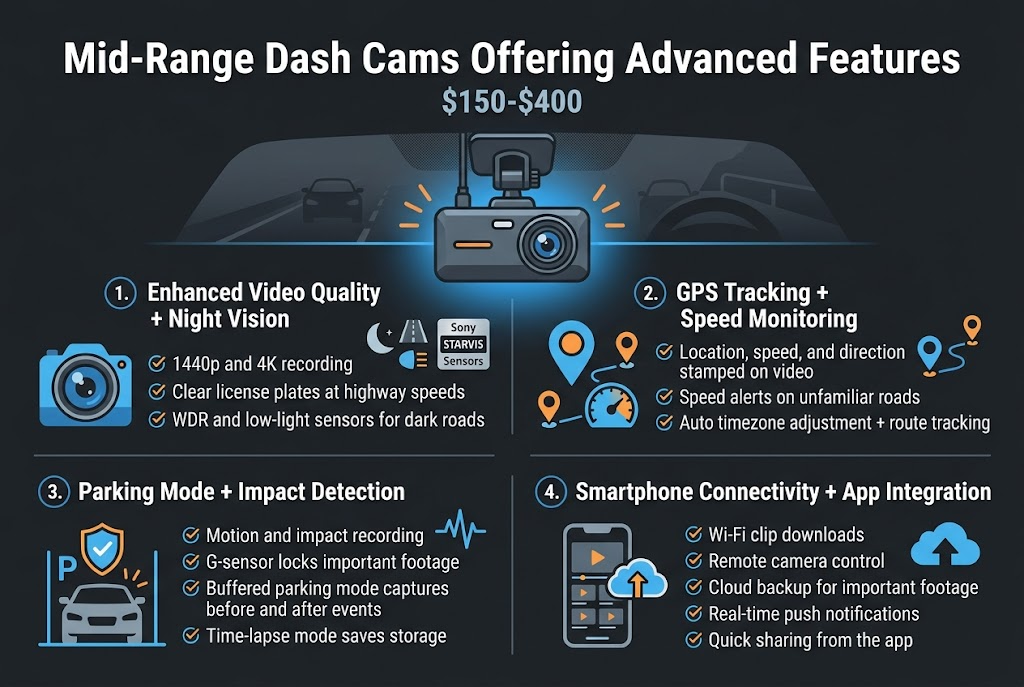
The $150-$400 price range brings you into serious dash cam territory with 1440p and 4K recording that captures license plates clearly even at highway speeds. These cameras use larger sensors and better lenses than budget options, making a huge difference during Australia’s harsh summer glare or sudden weather changes.
Night vision becomes a game-changer on country roads without streetlights or during those early morning commutes. Look for dash cams with wide dynamic range (WDR) and low-light sensors that automatically adjust exposure. The best models in this range can record usable footage even in near-darkness, which proves invaluable if you encounter wildlife or need to document incidents during overnight drives.
Sony STARVIS sensors appear in many quality mid-range models, delivering exceptional performance in challenging lighting conditions. These sensors work particularly well for capturing details in Australia’s variable lighting – from bright coastal drives to shadowy mountain passes.
GPS tracking and speed monitoring benefits
Built-in GPS transforms your dash cam into a comprehensive driving record keeper. Every video file gets stamped with precise location data, speed, and direction of travel. This information becomes crucial evidence if you need to prove your location during an incident or contest a traffic violation.
Speed monitoring works as your personal driving coach, helping you stay within limits on unfamiliar roads. Many drivers find this feature particularly useful when traveling through small towns with sudden speed changes or navigating construction zones where limits frequently shift.
The GPS data also enables advanced features like automatic timezone adjustment when crossing state borders and speed camera alerts in compatible models. Route tracking lets you review your journey later, which proves handy for business drivers who need to log travel for tax purposes.
Parking mode and impact detection features
Parking mode surveillance protects your vehicle even when you’re away, automatically starting recording when it detects motion or impact. This feature draws minimal power from your car’s battery while monitoring for vandalism, break-ins, or parking lot scrapes.
G-sensors detect sudden movements and automatically lock important footage to prevent overwriting. Modern systems use sophisticated algorithms that distinguish between normal vibrations (like trucks passing nearby) and actual impacts that need recording.
Buffered parking mode captures several seconds before and after detected events, providing complete context for incidents. Some models offer different sensitivity settings for various parking situations – higher sensitivity for quiet residential areas, lower for busy city streets with constant vibration.
Time-lapse parking mode offers another approach, condensing hours of footage into reviewable minutes while consuming less storage space. This works perfectly for documenting your car’s surroundings during long-term parking without filling your memory card.
Smartphone connectivity and app integration options
Wi-Fi connectivity eliminates the need to remove memory cards for footage review. Most mid-range dash cams create their own wireless network, letting you download clips directly to your phone within minutes of an incident. This speed can be crucial when dealing with insurance claims or police reports.
Dedicated smartphone apps provide remote camera control, letting you adjust settings, view live feeds, and manage storage without leaving your driver’s seat. The best apps organize footage by date and event type, making it easy to find specific clips weeks or months later.
Cloud storage integration automatically uploads important footage to secure servers, protecting evidence even if your dash cam gets stolen or damaged. Some services include automatic incident detection that immediately saves clips when crashes occur.
Push notifications alert you to parking mode events in real-time, so you’ll know immediately if someone hits your parked car. Location-based features can even remind you to turn on parking mode when you arrive at frequently visited destinations.
Social sharing features let you quickly share interesting footage or near-miss incidents, though always check local privacy laws before posting videos that show other drivers or license plates.
Premium Dash Cams With Professional-Grade Performance $400+
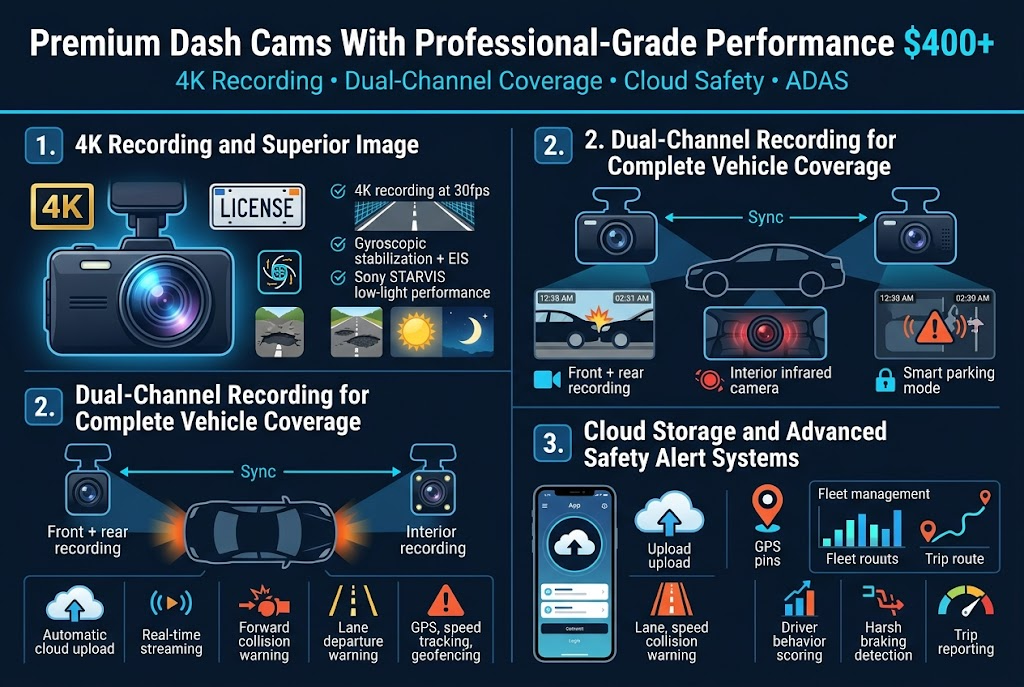
4K Recording and Superior Image Stabilization
When you’re spending over $400 on a dash cam, you expect nothing short of exceptional video quality. Premium dash cams deliver ultra-high-definition 4K recording at 30fps, capturing every detail with stunning clarity. This resolution proves invaluable when reading license plates, identifying road signs, or documenting accident scenes in crisp detail that holds up in insurance claims and legal proceedings.
The real game-changer lies in advanced image stabilization technology. Australian roads throw everything at your dash cam – from corrugated dirt tracks to pothole-riddled city streets. Premium models feature sophisticated gyroscopic stabilization and electronic image stabilization (EIS) that smooths out vibrations and jolts, producing professional-grade footage even on the roughest terrain.
High-end sensors like Sony’s STARVIS technology excel in Australia’s extreme lighting conditions. Whether you’re driving through the blazing outback sun or navigating poorly lit suburban streets after dark, these cameras automatically adjust exposure and white balance to maintain optimal image quality around the clock.
Dual-Channel Recording for Complete Vehicle Coverage
Premium dash cams come equipped with both front and rear cameras, creating a 360-degree security bubble around your vehicle. The rear camera typically records in 1080p or higher, capturing tailgaters, rear-end collisions, and parking incidents that single-camera systems miss entirely.
Some models feature interior cameras with infrared capability, perfect for rideshare drivers or fleet operators who need to monitor cabin activity. These cameras work flawlessly in complete darkness, documenting any incidents involving passengers or theft attempts.
The synchronization between cameras ensures timestamps match perfectly across all recordings. When an incident occurs, you get multiple angles of the same event, providing comprehensive evidence that’s difficult to dispute. Smart parking mode activates both cameras when the vehicle is parked, recording any suspicious activity or attempted break-ins.
Cloud Storage and Advanced Safety Alert Systems
Top-tier dash cams integrate seamlessly with smartphone apps and cloud storage platforms. Automatic upload features send critical footage directly to secure servers, ensuring evidence survives even if the camera gets damaged or stolen. Some models offer real-time streaming, allowing you to monitor your vehicle remotely or share live footage with emergency services.
Advanced driver assistance systems (ADAS) transform these cameras into active safety partners. Forward collision warnings alert you when following too closely, while lane departure warnings keep you centered during long highway stretches. These systems adapt to Australian road conditions, accounting for unique factors like kangaroo crossings and varying road marking standards.
GPS integration provides precise location data, speed tracking, and route mapping. Speed camera alerts warn you of upcoming enforcement zones, while geofencing capabilities can notify family members when vehicles enter or leave designated areas. Professional fleet management features include driver behavior scoring, harsh braking detection, and detailed trip reporting that helps businesses monitor vehicle usage and driver performance across Australia’s vast distances.
Essential Buying Guide for Australian Conditions
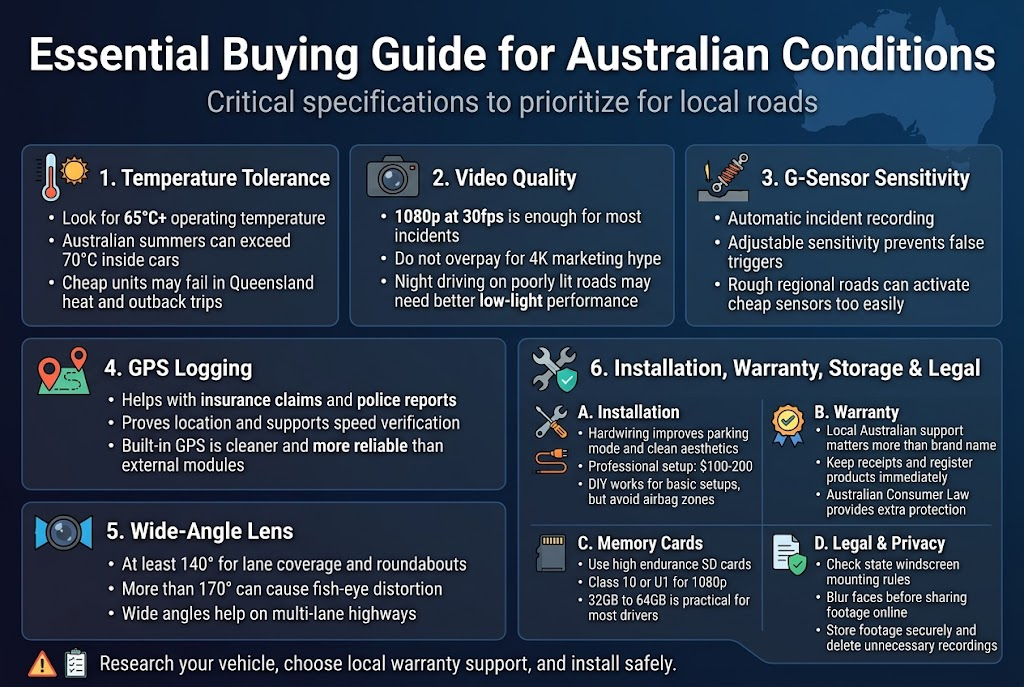
Critical specifications to prioritize for local roads
Australian road conditions throw unique challenges at your dash cam, and not every feature matters equally. Start with temperature tolerance – our summers can push interior car temperatures above 70°C, so look for cameras rated for at least 65°C operating temperature. Cheap units will fail during Queensland summer road trips or outback drives.
Video quality should be your second priority, but don’t get caught up in 4K marketing hype. Most incidents happen during the day when 1080p at 30fps captures license plates perfectly. Save money here unless you frequently drive at night on poorly lit roads.
G-sensor sensitivity becomes critical on our rough regional roads. You want automatic incident recording, but not every pothole triggering emergency mode. Look for adjustable sensitivity settings – roads between towns can be brutal on cheaper dash cams with overly sensitive accelerometers.
GPS logging adds massive value for insurance claims and police reports. Australian insurers increasingly request location data, and it helps prove you weren’t speeding. Built-in GPS costs more than external modules but offers cleaner installation and better reliability.
Wide-angle lenses (at least 140°) capture more lane coverage, essential for multi-lane highways and roundabouts. However, anything over 170° introduces fish-eye distortion that makes license plates harder to read at distance.
Installation requirements and professional setup considerations
Most quality dash cams require hardwiring for parking mode and clean aesthetics. Running cables through your dashboard isn’t rocket science, but modern cars pack electronics everywhere. One wrong move and you’re facing expensive airbag or sensor repairs.
Professional installation costs $100-200 but includes proper fuse tapping and cable routing. Installers know which fuses provide switched power (turns off with ignition) versus constant power (enables parking mode). They also understand airbag zones and avoid drilling through critical wiring harnesses.
DIY installation works for basic setups using cigarette lighter adapters, but you’ll have cables visible and lose parking surveillance. If going this route, invest in cable management clips and route wiring along existing trim pieces. Never run cables across airbag deployment zones or block driver vision.
Dual-channel systems (front and rear cameras) require running cables through your vehicle’s entire length. Professional installers have the tools and knowledge to remove interior panels safely. They’ll also ensure rear camera placement doesn’t interfere with rear defoggers or tinting.
Some vehicles need specific mounting considerations. Tesla owners often face unique challenges with glass roofs and autopilot sensors. European cars may require coding updates after electrical modifications. Research your specific vehicle before buying.
Warranty coverage and local customer support availability
International brands often provide global warranties, but getting repairs in Australia can be painful. Local distributors matter more than brand recognition. Companies like Navman, Uniden, and local importers provide Australian warranty service through established networks.
Check warranty terms carefully – many exclude “user error” which can include everything from memory card failures to heat damage. Water damage voids most warranties, despite claims of weather resistance. Keep receipts and register products immediately.
Response times vary dramatically between brands. Some offer next-business-day replacements through local distributors, while others require shipping to overseas service centers. Budget extra time during holiday periods when international shipping slows down.
Australian Consumer Law provides additional protection beyond manufacturer warranties. Goods must last a reasonable time based on price paid. A $50 dash cam might reasonably last two years, while a $400 unit should survive much longer. Document any defects and contact retailers first.
Consider extended warranty options for premium units. Some credit cards provide purchase protection, but exclusions often apply to electronic devices. Third-party warranty providers exist but read terms carefully – many exclude devices exposed to extreme temperatures.
Memory card compatibility and storage management tips
Not all memory cards work reliably in dash cams. High endurance cards designed for continuous recording last longer than standard SD cards. Samsung PRO Endurance, SanDisk High Endurance, and Transcend High Endurance series handle constant write cycles better.
Class 10 or U1 speed ratings provide minimum performance for 1080p recording. 4K cameras need U3 cards for consistent performance. Avoid generic or counterfeit cards – they fail when you need footage most. Stick to major brands from reputable Australian retailers.
Storage capacity depends on video quality and loop recording settings. 32GB typically provides 4-6 hours of 1080p footage before overwriting begins. 64GB cards offer better value per gigabyte and reduce overwrite frequency. Some cameras support up to 256GB cards.
Enable loop recording to automatically overwrite old footage. Set emergency recording to save important incidents permanently. Most cameras reserve portion of storage for protected files. Monitor storage regularly – corrupted cards can stop recording without warning.
Format memory cards monthly using your dash cam’s format function, not computer formatting. This optimizes file structure for continuous recording. Always keep spare cards for long trips where formatting isn’t practical.
Legal requirements and privacy considerations across states
Australian laws around dash cam usage remain largely favorable, but some restrictions apply. Recording audio requires consent from all parties in some situations, though this rarely applies to solo driving. Public road recording is generally legal, but private property rules differ.
Privacy laws vary by state regarding footage sharing. You can record for personal protection, but posting footage online without blurring faces may breach privacy regulations. Insurance companies and police are generally exempt from these restrictions when investigating incidents.
Windscreen mounting laws differ across states. Most allow small devices in designated zones, but exact placement rules vary. South Australia has specific restrictions on device placement. Check your state’s road rules before installation.
Some workplaces prohibit dash cams in company vehicles due to privacy concerns. Check employment contracts before installing personal cameras in work cars. Commercial drivers may face additional restrictions under transport regulations.
Store footage securely and delete unnecessary recordings regularly. Consider who has access to your footage and whether it could identify other people’s private activities. While dash cams provide valuable protection, use them responsibly to avoid privacy issues.
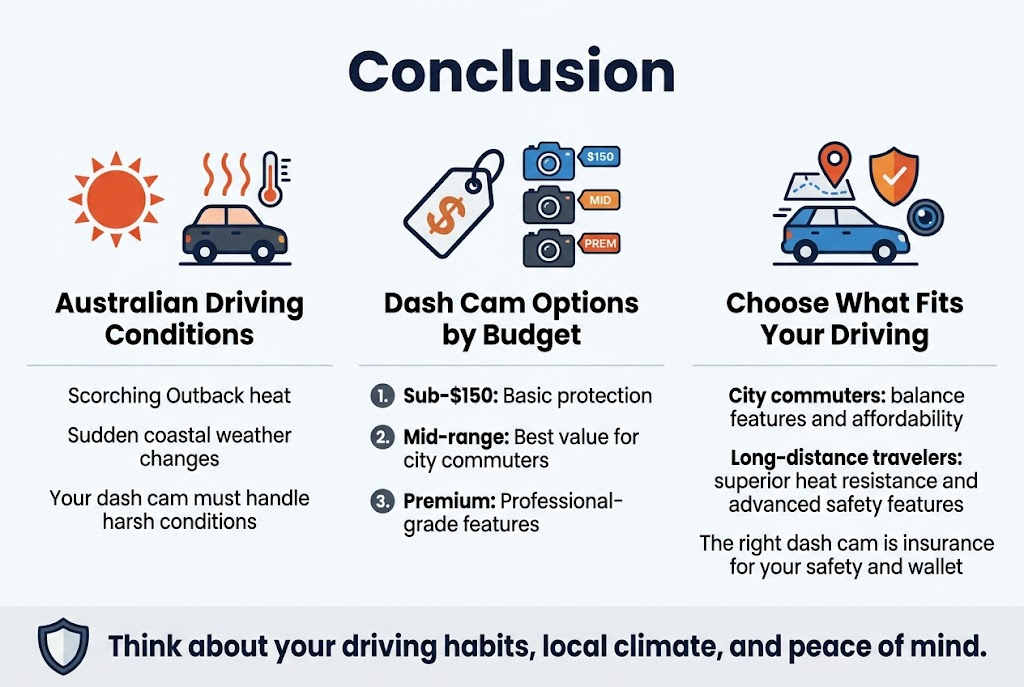
Australia’s unique driving conditions make choosing the right dash cam more important than just picking any camera off the shelf. From scorching heat in the Outback to sudden weather changes in coastal areas, your dash cam needs to handle whatever the road throws at it. The models we’ve covered span every budget and need – whether you’re after basic protection with a sub-$150 option or want professional-grade features that come with premium pricing.
Your perfect dash cam depends on how and where you drive most often. City commuters might find excellent value in mid-range options that balance features with affordability, while frequent long-distance travelers should consider investing in premium models with superior heat resistance and advanced safety features. Take time to think about your specific needs, local climate challenges, and how much peace of mind is worth to you. The right dash cam isn’t just a purchase – it’s insurance for your safety and wallet on Australian roads.